Educating to Empower: SPHM as a Catalyst for Safer Practice
Over four decades of research confirm that manually lifting patients poses serious risks to both healthcare workers (HCWs) and patients.
However, despite strong evidence supporting the use of SPHM to prevent harm to HCWs and facilitate patient safety, most U.S. healthcare education programs fail to incorporate SPHM training.
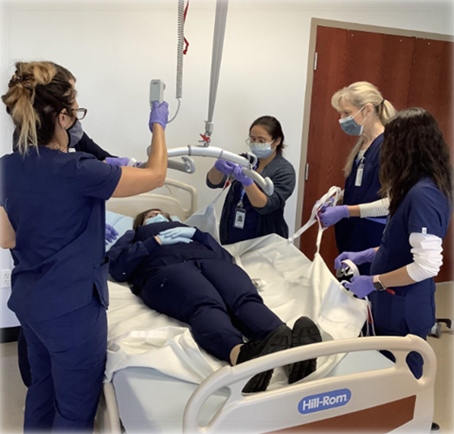
Many programs still teach outdated practices that emphasize proper body mechanics to prevent injury during manual patient handling, leaving new graduates unprepared to safely assist patients. This lack of training exposes both students and their patients to unacceptable risks. Without adequate SPHM education, students face increased injury risks during clinical internships, with some experiencing injuries before graduation.
Faculty have an ethical obligation to teach evidence-based standards and practices as required by professional associations and accreditation bodies. Integrating SPHM principles into student curricula aligns with current healthcare standards and ensures graduates enter the workforce equipped to protect both themselves and their patients.
Health care education programs, in collaboration with clinical partners, can drive culture change by equipping students with the knowledge and skills necessary to safeguard their well-being and that of their patients. To address these gaps, ASPHP recently published a white paper, SPHM Education in Healthcare Student Curriculum.
This white paper, informed by an extensive literature review and faculty input from nursing and therapy programs, examines the reasons for the limited integration of SPHM in U.S. health care curricula and proposes solutions to improve its adoption. Key highlights include:
- Strategies to overcome challenges in integrating SPHM into student curricula.
- A concise overview of SPHM science and its benefits for caregivers, patients, students, schools, and health care organizations.
- Evidence-based training methods and real-world examples of successful SPHM integration in nursing, physical therapy, and occupational therapy programs.
- Practical recommendations for academic programs and faculty to better prepare students to practice safely and prevent injury.
The ASPHM Curriculum Task Force developed the following tools to provide educators with strategies and resources to help incorporate SPHM into healthcare education programs.
The Case for Integrating SPHM into Healthcare Student Curriculum – info sheets for the following programs:
- Physical and Occupational Therapy (PDF)
- Nursing (PDF)
- Medical Imaging & Radiation Therapy (PDF)
- Nursing Assistant (PDF)
Integrating SPHM into Healthcare Student Curriculum – How to get started
Guidance and free resources to help you:
- A brief guide to getting started (PDF)
- Posters (PDF)
- Instructional resources (PDF)
- Presentations – PDF of 2 PPTs from ASPHP 2024 (PDF)